

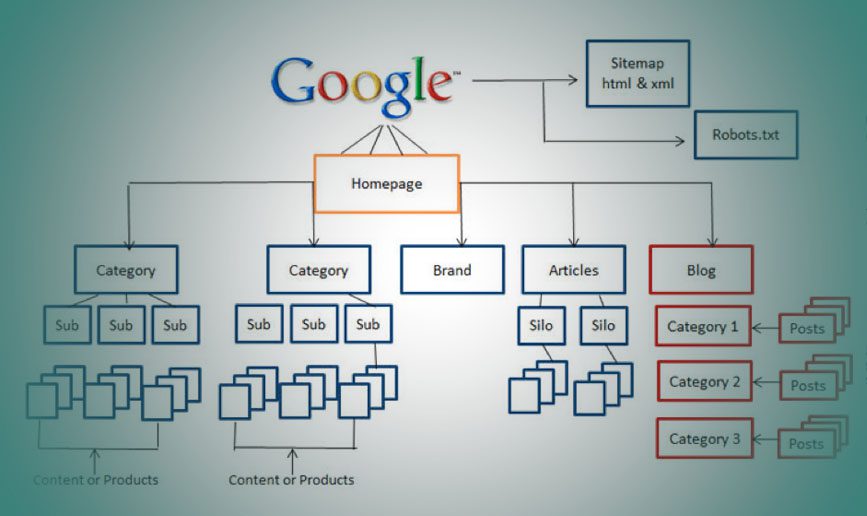
Think of Information Architecture as the blueprint for your website. Just as an architect decides where the walls, stairs, and doors go in a house to make it livable, an efficient website designer uses IA to organise and label content so users can find what they need without getting lost.
At its core, IA is about structure and clarity. It transforms a pile of raw data and features into a logical system. It focuses on three main pillars:
Navigation: How users move through the site (menus, breadcrumbs, and links).
Hierarchy: How information is ranked (what is a primary category vs. a sub-category).
Labeling: Ensuring names for pages and buttons are intuitive and consistent.
Without solid IA, even the most beautiful website becomes a “digital junk drawer.” Users feel overwhelmed by choices or frustrated by “dead ends.” By using information architcture appropriately, designers ensure the path from a user’s initial question to their final answer is as short and logical as possible.
In short: IA is the skeleton; UI is the skin. You need the bones to be in the right place before you can make the body look good.
How can eseyo help you with Information Architecture?
We’ll happily take a look at your website and review how sensibly things have been setup, making recommendations about what can be changed and why. Obviously, any projects that we build will have good Information Architecture as a default.

Useful articles and resources about website design from our Help Center
What our clients have to say...
Very professional company . I would recommend Scott and his team for all your website or email needs . The website designs they produce are exceptional but at a cost effective price.

Scott’s knowledge and expertise is first class. We work very closely with the Eseyo team on a range of digital projects and we find the responsive and collaborative work ethic very refreshing.
I have been using Eseyo for about 6 months and am so happy with them. Please look no further than Eseyo, you will not go wrong. They are very friendly, reliable, knowledgable, affordable and so approachable. I feel very lucky to have Scott and the rest of Eseyo in our corner!
ESEYO designed my website, I would highly recommend them they are very knowledgeable, efficient and professional.
I had chosen Scott because I believe he is the best. He has done a website for another company who is similar to mine.
So if my company can become as successful as that I will be over the moon. Scott was very easy to talk to and has made an absolute gem of my new website. I would highly recommend him.
Excellent service. Highly recommend Scott
Excellent professional service – Thoroughly recommend to anyone, My website was fully designed and set up for me very smoothly indeed.
Eseyo created our website – Brentwood Lofts – and our business is booming! In fact we’ve just completed our highest quarter since establishing, back in 1985. Whilst a great deal of our work comes from referrals, owing to the fact that we have been trading for so long, we’re convinced the upturn is due to the success of our website. Well done and thanks to Scott and his team.
Scott at Eseyo is the web guy for my business. Websites, the internet and emails can be very complex subjects and Scott is able to explain them all very clearly. He just does it all. I couldn’t run my business the way I do without Scott.
Scott carried out a “quick” SEO audit on our website, which turned out to be far more detailed than we were expecting. The insights have been enlightening, and most of the recommended changes have been very straightforward to implement. Thanks for helping us out — we look forward to working together in more detail in 2027.
We’re on about the 5th incarnation of our website, we’ve wasted thousands! But Scott was the first guy we’ve dealt with who listened and got it right. Happy to recommend.
Scott collaborated in creating a brand new website for The Albert Hunt Trust. An efficient, professional, approachable service. Thank you.